
The dream of witnessing Mount Everest, Earth’s highest peak, has captivated human imagination for generations. While summiting requires months of preparation, extreme fitness, and considerable risk, experiencing Everest’s majesty has become remarkably accessible through helicopter tours. The journey from Kathmandu to Everest Base Camp by helicopter transforms what was once an expedition reserved for elite mountaineers into an achievable adventure for travelers from all backgrounds, delivering one of the planet’s most extraordinary experiences within a single day.
Why Kathmandu: The Capital as Your Starting Point
The Everest Helicopter Tour from Kathmandu begins in Nepal’s vibrant capital, a city where ancient temples coexist with modern development and where mountain culture permeates daily life. Starting from Kathmandu offers distinct advantages for international travelers, as most visitors arrive at Tribhuvan International Airport and base themselves in the capital city. This eliminates the need for additional domestic flights or ground transportation to other departure points, streamlining logistics considerably.
Kathmandu sits at approximately 1,400 meters elevation in a bowl-shaped valley surrounded by terraced hills. From this central location, the helicopter journey covers roughly 140 kilometers to reach Everest Base Camp, with flight times typically ranging from 45 minutes to one hour each way. This distance allows passengers to witness Nepal’s dramatic geographic transition from subtropical valley to high Himalayan terrain, creating an educational journey alongside the visual spectacle.
The capital’s helicopter operators maintain sophisticated fleets specifically equipped for high-altitude mountain flying. These aircraft feature powerful engines capable of operating efficiently in thin air, advanced navigation systems, and safety equipment meeting international aviation standards. The competitive market in Kathmandu also provides travelers with options across price ranges and service levels, from budget-conscious shared flights to luxury private charters with customized itineraries.
The Flight Path: Urban to Ultimate Wilderness
Departing Kathmandu, helicopters typically lift off in early morning hours when weather conditions throughout the route offer maximum stability and visibility. The initial minutes of flight provide aerial perspectives on Kathmandu Valley’s urban sprawl, historic sites, and the patchwork of agricultural land that sustains the region’s population. The Bagmati River snakes through the valley, connecting sacred sites and serving as a geographic spine for the metropolitan area.
As the helicopter climbs eastward, the landscape transforms with remarkable speed. Terraced hillsides appear as abstract art when viewed from above, their contours revealing centuries of agricultural engineering adapted to steep terrain. Traditional villages dot the ridgelines, their orange and red roofs creating color contrasts against green vegetation. The increasing remoteness becomes apparent as roads disappear, replaced by narrow footpaths connecting scattered settlements.
The middle segment of the journey crosses increasingly rugged terrain where deep gorges carved by glacial rivers create dramatic topography. The helicopter may follow the Sun Kosi or Dudh Kosi river valleys, these powerful waterways originating from Himalayan glaciers and carrying enormous volumes of sediment toward the Ganges system. Suspension bridges span impossible-looking gaps, testimony to human determination to maintain connections across challenging geography.
The final approach to the Everest region brings the great peaks into view. Weather permitting, passengers see the entire Himalayan panorama unfold—Cho Oyu, Lhotse, Nuptse, Ama Dablam, and ultimately Everest itself rising above all others at 8,849 meters. This reveal often triggers profound emotional responses as abstract knowledge transforms into concrete reality. The mountains’ scale defies easy comprehension, their vertical relief creating optical illusions that the mind struggles to process.
Kala Patthar: The Premier Viewpoint
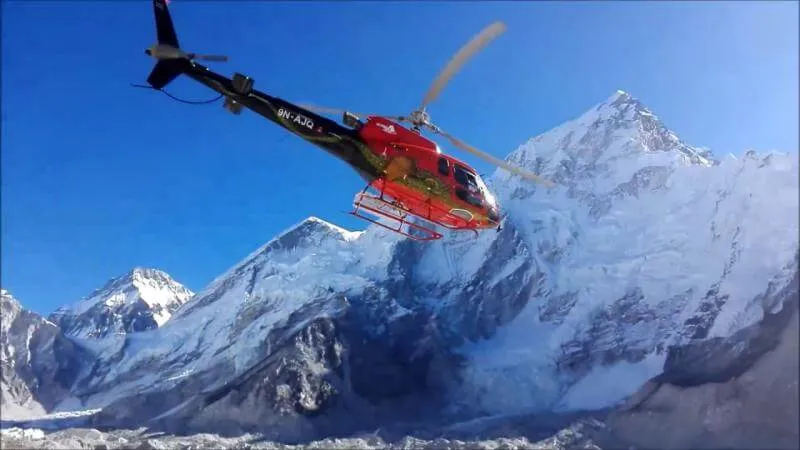
Most Everest helicopter tours from Kathmandu include a landing at Kala Patthar, situated at approximately 5,550 meters. This rocky outcrop serves as the primary viewpoint for Everest Base Camp trekkers who make the pre-dawn climb to watch sunrise illuminate the world’s highest peak. For helicopter passengers, landing here provides an unobstructed panorama that includes Everest’s summit, the South Col where climbers establish their highest camps, and the surrounding giants that form this supreme mountain landscape.
The landing at this extreme elevation allows passengers to step onto Himalayan ground and experience high-altitude conditions firsthand. The air contains roughly half the oxygen available at sea level, making even small movements require noticeable effort. Temperatures can be well below freezing regardless of valley conditions, with wind chill factors adding to the cold’s intensity. These physical sensations—the breathlessness, the biting cold, the thin air’s peculiar quality—create visceral memories that photographs alone cannot capture.
Tour operators typically allow 10 to 15 minutes at Kala Patthar, balancing the desire for adequate time to absorb the setting against altitude safety considerations. This duration permits photography from multiple angles, short walks to different vantage points, and moments of contemplation about the landscape’s overwhelming presence. Many visitors describe the experience as spiritual, standing in silence before peaks that have represented ultimate challenges to human ambition for over a century.
The Everest View Hotel Stop
The journey from Kathmandu to Everest Base Camp by helicopter commonly includes a breakfast or refreshment stop at the Everest View Hotel in Syangboche, positioned at 3,880 meters. This remarkable establishment, recognized by Guinness World Records as the world’s highest-placed hotel, offers panoramic windows framing Everest, Lhotse, and Ama Dablam. The stop serves multiple purposes: it provides gradual altitude acclimatization before ascending to Kala Patthar, offers warmth and refreshment after time in the cold, and creates opportunities for social interaction with fellow travelers.
The hotel itself represents an extraordinary feat of logistics and determination. Every building material, furniture piece, and food item arrived either by helicopter or through multi-day porter carries from lower elevations. The staff who operate the hotel live at this altitude year-round, demonstrating the remarkable human capacity for adaptation to extreme environments. Understanding this context adds appreciation for the hot coffee or tea served while you gaze at Everest through floor-to-ceiling windows.
Comparing Direct and Multi-Stop Itineraries
Everest helicopter tours from Kathmandu operate under various itinerary structures. Direct flights maximize time at base camp or Kala Patthar by minimizing stops, appealing to those focused exclusively on the mountain experience. Multi-stop itineraries incorporate landings at Lukla, visits to Namche Bazaar, or extended time at the Everest View Hotel, providing broader cultural context and opportunities to observe Sherpa communities up close.
The choice between these approaches depends on personal priorities. Direct flights suit travelers with tight schedules or those primarily interested in the natural spectacle. Multi-stop tours appeal to those seeking cultural immersion alongside mountain views, though they require additional time and typically command higher prices. Both approaches deliver the essential experience of witnessing Everest from privileged perspectives unavailable to those who remain on the ground.
Practical Considerations and Planning
Booking an Everest helicopter tour from Kathmandu requires attention to several practical factors. Weather dependency cannot be overstated—mountain weather patterns determine operational feasibility, and even confirmed bookings may face last-minute postponements when conditions deteriorate. Building schedule flexibility into your Kathmandu itinerary proves essential, ideally allowing two or three potential departure days to accommodate weather delays.
Costs vary significantly based on whether you book a seat on a shared flight or charter a private helicopter. Shared flights provide economical access to the experience by distributing costs among four to five passengers, while private charters offer schedule control, route customization, and the ability to create a personalized journey. Prices also fluctuate seasonally, with peak demand during October-November and March-May typically commanding premium rates.
Physical preparation requires less intensity than trekking but shouldn’t be ignored entirely. The rapid altitude gain can trigger symptoms in susceptible individuals, including headaches, nausea, or dizziness. Staying well-hydrated before and during the tour, avoiding alcohol the previous evening, and moving deliberately while at high altitude help minimize these effects. Those with serious cardiovascular or respiratory conditions should consult physicians before booking.
Conclusion
The Everest helicopter tour from Kathmandu represents a remarkable democratization of mountain access, bringing the world’s highest peak within reach of anyone capable of boarding an aircraft. This journey from Kathmandu to Everest Base Camp by helicopter condenses weeks of traditional trekking into hours of spectacular flying, delivering authentic encounters with Himalayan grandeur without requiring extreme fitness or extensive time commitments.
For those who choose this aerial approach, the rewards extend beyond convenience. The bird’s-eye perspective reveals landscape patterns and geographic relationships invisible from ground level, while the rapid transitions through elevation zones demonstrate Nepal’s extraordinary vertical diversity. Standing at Kala Patthar with Everest towering overhead creates memories of profound natural beauty that persist long after returning to sea level.
Whether motivated by time constraints, physical limitations, or simple preference for aerial exploration, helicopter passengers consistently report that witnessing Everest justifies the investment. The mountain’s presence—its massive scale, its harsh beauty, its representation of ultimate natural challenges—affects people deeply regardless of how they approach it. In making this approach possible for broader audiences, Everest helicopter tours from Kathmandu fulfill an important role in contemporary adventure travel, proving that extraordinary experiences need not always demand extraordinary sacrifice.